
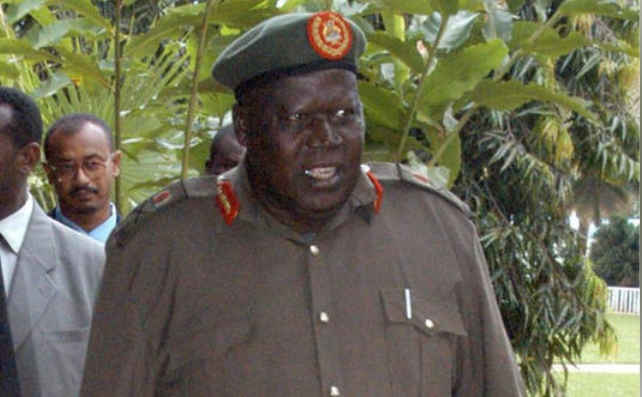
Story by Telegraph Obituaries
Moses Ali, who has died aged 87, was a great survivor under two Ugandan dictatorships; a henchman of Idi Amin, whom, as a junior army officer, he helped to power in the 1971 coup d’état, he later served as a minister under Yoweri Museveni.
In both cases he felt the force of arbitrary rule. In 1978 Amin sacked him as finance minister, accusing him of gross corruption, forcing him to flee Kampala to avoid arrest. In 1990, under Museveni, he was jailed for over two years for treason, terrorism and illegal possession of firearms, charges of which he was eventually cleared by the High Court.
During the second presidential term of Milton Obote, his first having been terminated by Amin, Ali led the rebel Uganda National Rescue Front from southern Sudan in the Ugandan Bush War, later integrating his force with the National Resistance Army (NRA) under Museveni, who became head of state in 1986.
In 2001 Ali survived an assassination attempt on his way to a Cabinet meeting in the capital.
Despite these vicissitudes, he ended up holding three of the top government posts. Between 1995 and 2026 he was twice first deputy prime minister, four times second deputy PM and twice third deputy PM. He served continuously as a member of the National Assembly from 1996 until his death, first representing East Moyo County, then, after boundary changes, Adjumani West County. He was Uganda’s oldest MP.
Known as “the lion of Adjumani” and the champion of the West Nile region from where he came, he was a giant of a man able to shift between military and civilian roles and resilient enough to ride the inevitable ups and downs of an often-violent polity.
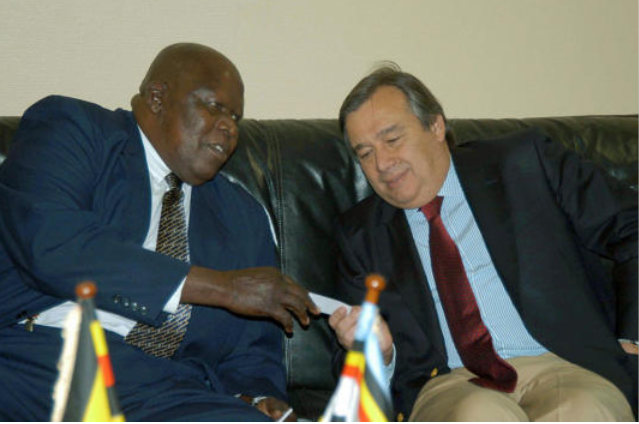
Ali in 2005 with the UN High Commissioner for Refugees, António Guterres, in Entebbe, Uganda – PETER BUSOMOKE/AFP via Getty Images
Moses Ali was born on April 5 1939 in Adjumani District in the northern part of what was then the British Protectorate of Uganda, and was educated at church schools and Old Kampala Secondary School.
He taught briefly at two church schools before joining the army. In 1969 he was commissioned second lieutenant in the paratrooper school and undertook training in Israel. Under Amin he was promoted to the rank of major and appointed commander of the school.
In 1972 he became a colonel and attended the Staff College at Camberley in Surrey. The following year he received his first portfolio as the provincial administration minister. Continuing his twin military/civilian rise, he became a brigadier and finance minister in 1975, the second post held until his sacking three years later, Amin being suspicious of the popularity he had gained through his championing of a Muslim charity. Like Amin, Ali was a Muslim in a Christian majority country.
After Uganda had been defeated in its war with Tanzania in 1979 and Amin had fled to Libya, Ali led an armed rebellion against his successor, Obote, from southern Sudan. His success as a guerrilla leader enabled him to negotiate favorable terms with Museveni, head of the main rebel force, the NRA. He was promoted to the rank of major general and was appointed youth, culture and sports minister. In 1994 he became tourism minister.

Gen Ali addressing guests during national celebrations to mark World Tourism Day at the Jinja Rugby grounds in Uganda – Donald Kirya/Alamy
In 2003 he was promoted lieutenant general and gained a Certificate of Higher Education in Law at the University of Wolverhampton. He was later awarded a BA in law by Makerere University in Kampala and a diploma in legal practice by the Law Development Centre in the capital. He was formally called to the Bar at the age of 73.
In 2012 he became a four-star general and in 2015 was awarded a MA at the American Military University, part of a higher education system based in Charles Town, West Virginia.
During his numerous spells as a deputy prime minister, Ali was also responsible for tourism, wildlife and antiquities, tourism, trade and industry, internal affairs, disaster preparedness and refugees, and government business in parliament.
Ali practised polygamy and was thought to be the father of about 30 children. Among his wives was Aisha, who died suddenly in 2011, aged 51, in Dubai on her way for medical treatment in India, and Sarah, who died in Kampala in 2024 of a kidney disease while awaiting a transplant in India. Of his children, Siraj Musa Ali, a lawyer, was appointed Minister of State for Works in May, the same month that his father’s long ministerial career came to an end.
Moses Ali, born April 5 1939, died July 18 2026