Story by Simon Murphy
Key takeaways
- Mass Migration: Around 60,000 migrants entered Ceuta from Morocco, causing a humanitarian crisis with at least 34 deaths from drowning and stampedes.
- Government Response: Spanish PM Pedro Sanchez condemned the breach as a violation of territorial integrity, blaming human smugglers; Spanish forces and military reinforcements are aiding humanitarian efforts.
- Border Tensions: Moroccan forces used tear gas, water cannons, and warning shots to control crossings, while many migrants continue attempting dangerous sea and land entries.

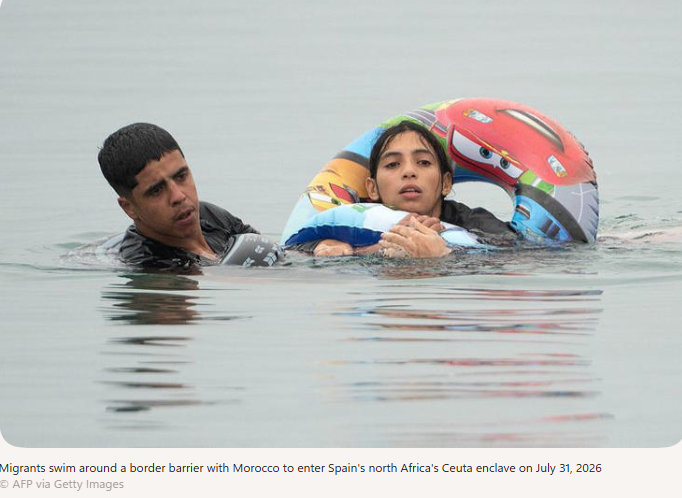
Migrants swim around a border barrier with Morocco to enter Spain’s north Africa’s Ceuta enclave on July 31, 2026© AFP via Getty Images
Clinging to a child’s inflatable, a woman swims for land with a male companion. This is just one of the desperate scenes unfolding as migrants bid to reach the tiny Spanish enclave of Ceuta in north Africa.
At least 57 people have died, with some 60,000 migrants entering from Morocco during the border crisis – equivalent to about 70% of the self-governing city’s population. Among the dead are said to be some who drowned.
Spain deployed its armed forces and extra police to restore order in Ceuta. The rush comes after Spain’s Supreme Court earlier this month ruled migrants arriving by sea could not be summarily deported – unlike those who cross by land or climb the border fence.
A member of Moroccan security forces gestures to a man carrying a child close to the site of clashes near Fnideq, on the Morocco-Spain border, on July 31, 2026© AFP via Getty Images
Ceuta’s president, Juan Jesus Vivas, who on Friday provided the figure for the migrants who had entered the territory in the previous 24 hours, said: “The situation that Ceuta is going through is absolutely unsustainable.”
And, in a visit to Ceuta on Friday, Spanish PM Pedro Sanchez condemned the breach of the border, describing the events as “a violation of Spain’s territorial integrity”. He cast blame on human smugglers, saying they “deceive so many young people, and ultimately lead many of them to their deaths – whether in the ocean or, as in this case, at Spain’s border in the autonomous city of Ceuta”.
Meanwhile, Spain’s interior ministry released its own figures on Friday estimating some 50,000 people had crossed from Morocco since Thursday. It added that 37,500 had already returned to Morocco, with hundreds more going back by the hour.
The crisis continued on Friday with security forces clashing with migrants on the Moroccan side of the border. Footage of the border showed hundreds of migrants gathered on a hill overlooking Ceuta being dispersed with tear gas by Moroccan forces, as others continued to swim to the Spanish enclave.
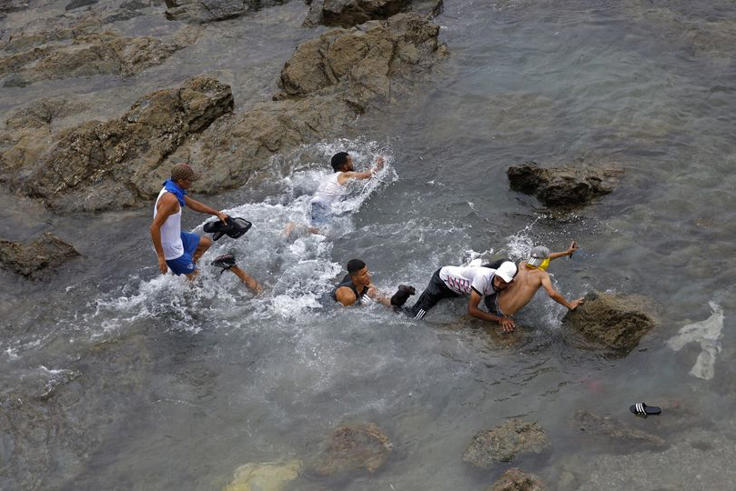
People try to swim through the waters close to the fence near Fnideq, on the Morocco-Spain border, on July 31, 2026© AFP via Getty Images
Meanwhile, large groups of migrants walked back from Ceuta towards Morocco to return home. Rachid Sbihi, who leads a local workers association representing Civil Guard officers, called the situation a “serious humanitarian crisis”.
Thousands of migrants, including unaccompanied children, were left sleeping in parks and on pavements, while others roamed the streets aimlessly, according to Mr Sbihi. He said: “It’s chaotic.”
Some drowned, Mr Sbihi said, but some were also killed in a stampede to cross the breakwater fence at Tarajal beach, near a border checkpoint with Morocco.
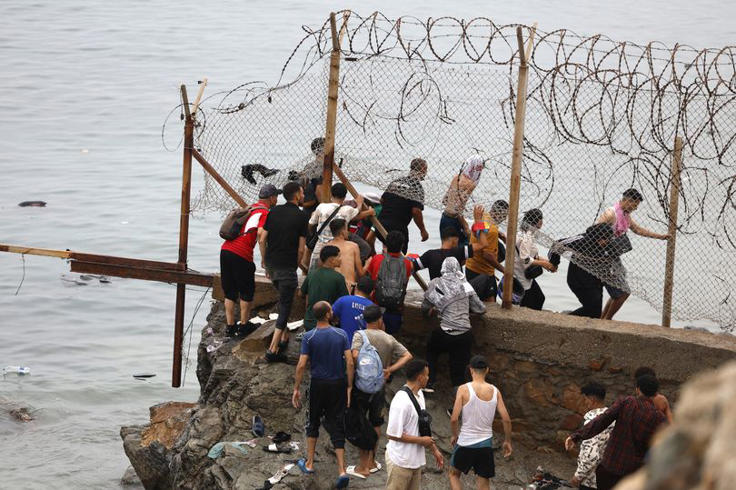
People gather along the fence close to the site of clashes near Fnideq, on the Morocco-Spain border, on July 31, 2026© AFP via Getty Images
Moroccan Ahmed Karim, 33, explained he had crossed into Ceuta because of the lack of jobs in his country. He said: “Many people want to go to Europe, America, but they don’t have the opportunity.”
On Friday morning, the waters near the border fence were littered with buoys, shoes and other belongings left behind. Moroccan police deployed additional personnel, used water cannons and fired warning shots into the air to prevent migrants from crossing into Ceuta, according to rights groups in Morocco.
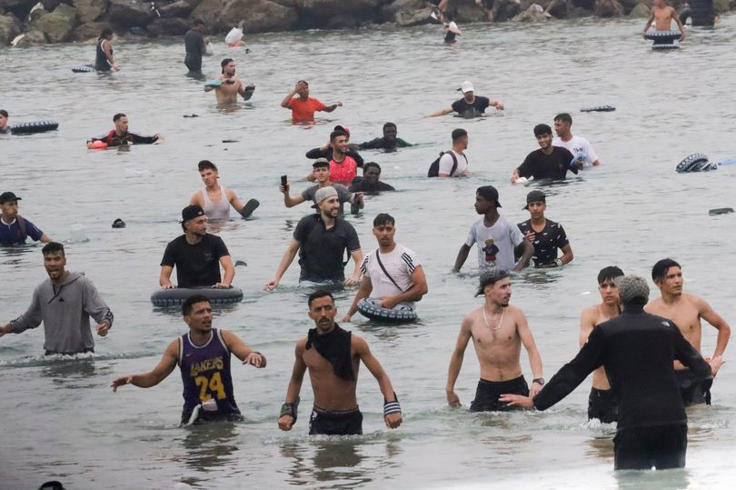
A group of migrants near the Tarajal border crossing in Ceuta, Spain, 31 July 2026© REDUAN DRIS/EPA/Shutterstock
Achraf Maimouni, a human rights activist in Fnideq, the Moroccan city bordering Ceuta, said: “Despite the heavy police presence, people crossed through the waterway, while the land border remained closed.” Migrants arrested at the border were taken farther into Morocco, away from Ceuta, “but people are still coming,” he said.
Spain is a main point of arrival into Europe for migrants seeking better economic opportunities or who are escaping violence. To reach Ceuta, migrants often swim from the Moroccan town of Fnideq, covering about three miles to reach Spanish territory.
Others attempt the crossing from the nearby town of Belyounech, where the distance is shorter. Migrants from Morocco also attempted to cross into Melilla, Spain’s other territory at the tip of north Africa.
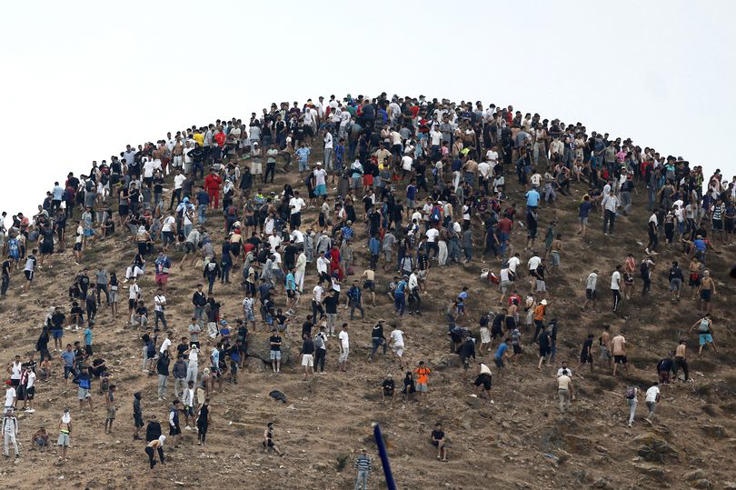
People gather on a hilltop close to the site of clashes near Fnideq, on the Morocco-Spain border, on July 31, 2026© AFP via Getty Images
There was widespread chaos in Bni Nsar, the Moroccan town bordering the Spanish territory, where migrants clashed with police, throwing rocks and setting police vehicles ablaze, according to local media and rights groups. They reported injuries among security forces and the arrest of dozens of people attempting to cross.
Omar Naji, of the local branch of the Moroccan Association of Human Rights, said that the crossing attempts into Melilla appeared to be linked to the situation in Ceuta. Like Ceuta, Melilla is a Spanish autonomous city with many Moroccans considering both cities to be occupied territory.
The UK’s PM Andy Burnham said on Friday the UK was “making contact with the Spanish… to provide support”. Asked about the scenes in the territory, Mr Burnham said: “Obviously that’s a matter for the Spanish government first and foremost, but it is a cause for concern.
“And we are making contact with the Spanish government, the Spanish authorities, to provide support but also to understand the implications of that situation.”