Story by Graham Keeley
Migrants are using social media to plan another mass border crossing into Ceuta.
At least four WhatsApp groups, 10 Facebook groups and more than 50 Instagram accounts have been used to discuss plans to cross from Morocco to the Spanish exclave on Aug 15, according to analysis by Maldita.es, a fact-checking non-profit group.
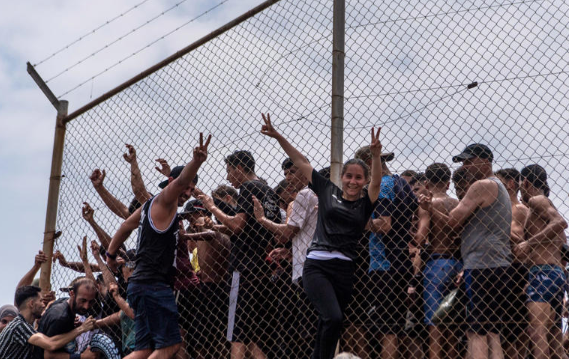
There was a mass influx into Ceuta last week, when at least 70,000 people swam and charged through the border, prompting a diplomatic row over Spain’s handling of the migration crisis.
The crossing left at least 77 people dead, with migrants drowning as they tried to swim around a barrier in the Mediterranean.
One message, which includes the Spanish flag, said: “Everything will be clear that day and we will get there.”
Migrants are urged to rally in Castillejos, which Moroccans call Fnideq, near the Ceuta border.
The messages show detailed maps, instructions and advice on what to wear and where in Morocco to set off from. Most of the messages were written in Arabic but a few were in French, suggesting they might be directed at sub-Saharan Africans.
Five Facebook groups – with a combined audience of more than 400,000 members – were analysed by El País newspaper, which found that some messages expressed doubts about the supposed plan.
One message said: “Hey brothers. Is anything happening on the 18th? Or the 30th? Or in 2030?” Another said: “Are you going on the 15th? You won’t find transport. I’m right by the customs gate.”
Other people posting appear to believe the crossing might be to Melilla, Spain’s other exclave in North Africa.
One message said: “Guys, for those passing through Beni Ensar – the entry point to Melilla – explain the plan to us: how do you cross there? I tried to get in, but the Civil Guard turned me back.”
Asked about the possibility of another mass crossing into the Spanish enclave next week, Fernando Grande-Marlaska, the Spanish interior minister, told reporters at a press conference on Tuesday: “We will put all the resources necessary for any situation.”
Olaya Salardón, of the United Association of the Civil Guard union, told TVE, a Spanish broadcaster, that officers would do what they could if faced with a new incursion into Ceuta.
She said: “We will always follow the established protocols despite the great pressure we are under. We are 100 officers, but we have always called for more resources.”

Migrants wait for food and water from the Red Cross following the mass crossings into Ceuta – Pedro Nunes/Reuters
Any fresh assault on the frontier between Morocco and Ceuta will depend on the actions of the Moroccan police.
In September 2024, thousands of Moroccan riot police stopped a march on Ceuta that had been organised on social media.
They closed roads, put controls in place, made arrests and charged some would-be emigrants who had managed to evade the police operation. Since then, there have been other attempts, but they have managed to mobilise far fewer people.
Morocco has blamed a pro-migration Spanish court ruling for the surge in crossings.

At least 77 people died as thousands of migrants swam from Morocco to Ceuta last week – Getty
A Moroccan official said on Tuesday that his country had warned Spain the decree would become a “problem”, because it had blocked immediate deportations of people arriving by sea.
Madrid refuted the claim almost immediately, saying “criminal mafias” were responsible.
On Wednesday, Spain’s Left-wing Sumar party presented a bill to congress that would prevent Spain front jointly hosting the 2030 Fifa World Cup with Morocco as planned, citing “serious human rights abuses”.
The government, Sumar said, should “carry out a specific review and evaluation of the current joint organisation model” of the event, which will also be co-hosted by Portugal.
EU interior ministers have called for tougher action against migrant smuggling networks and stronger returns policies.
In a meeting on Tuesday, the ministers urged closer cooperation with countries outside the EU to curb irregular migration and prevent a repeat of the surge.