Story by Poppy Wood, Erin Spurling
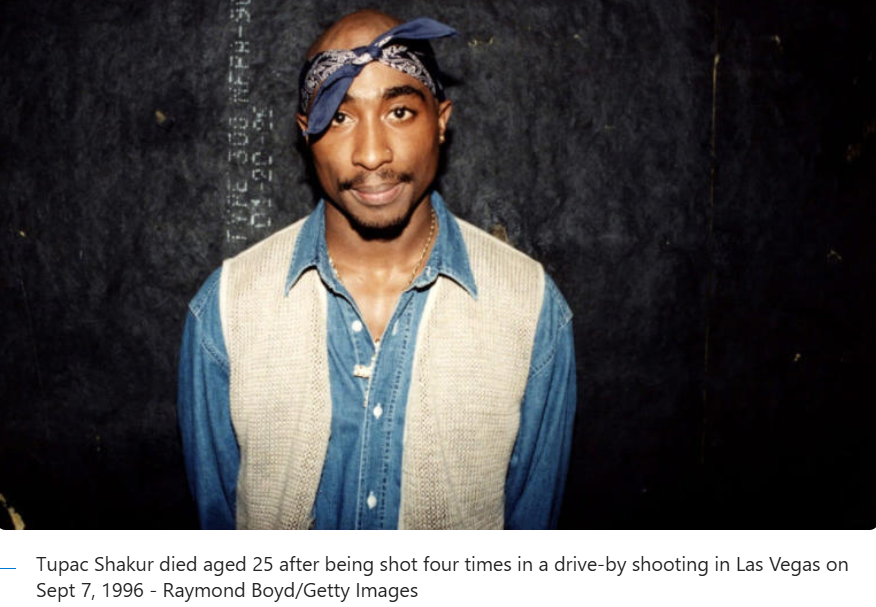
A murder trial in the death of Tupac Shakur will start on Monday, nearly 30 years after the hip-hop star was shot dead in Las Vegas.
Shakur was struck four times in the drive-by shooting on Sept 7, 1996 and died in hospital six days later, aged 25. The rapper, already a number one Billboard success during his lifetime, was soon mythologised in death.
Police never recovered the gun used to shoot Shakur, nor the car from which the shots were fired. It has allowed conspiracy theories, online conjecture and gang folklore to proliferate in the decades since.
But state prosecutors in Nevada hope to find some answers in a high-profile trial starting this week, in which Duane “Keffe D” Davis, 63, is charged with one count of murder with the use of a deadly weapon.
While the self-described gangster is the only person to have ever been charged in connection with Shakur’s death, Mr Davis is not accused of pulling the trigger. Instead, prosecutors allege that he was the shot caller in the incident and provided the weapon. Mr Davis has pleaded not guilty.
In a month-long trial, the prosecution is expected to rely unusually heavily on one key source: Mr Davis’s own admissions, in person and in an autobiography.
The former South Side Compton Crips leader signed a “proffer” agreement with police in 2008, in which he shared information about the shooting in exchange for immunity for those statements.

‘Keffe D’ Davis is the only person to have ever been charged with Tupac’s death – Bizuayeha Tesfaye/AFP
Prosecutors allege that the former drug dealer later violated this agreement when he began talking about the incident in a slew of media appearances – first in documentaries and podcasts, and ultimately in a detailed autobiography.
They claim that this now allows them to try to prosecute Mr Davis over his connection to Shakur’s murder.
The former gangster has boasted about being one of four people in the white Cadillac that pulled up to Shakur’s car on the night he was sprayed with bullets.
The other three have since died. They are thought to have included Terry “Bubble Up” Brown, the driver; Orlando “Baby Lane” Anderson, Mr Davis’s nephew; and Deandrae “Freaky” Smith.
All were associated with the South Side Compton Crips gang, based in California, and were in town to watch a Mike Tyson fight in Las Vegas the weekend that Shakur was killed.
Security footage from the city’s MGM hotel at around 9pm on the evening of the shooting shows a bust-up between Shakur’s entourage and Anderson as part of a deep-seated gang feud. Mr Davis’s nephew was punched and kicked in the tussle.
In his 2019 autobiography, Compton Street Legend, Mr Davis claimed that Anderson told his uncle about the beating.
The self-proclaimed kingpin said that, enraged, they decided to follow Shakur and his associates to Club 662. The private nightclub was owned by Marion “Suge” Knight, the chief executive of the rapper’s record label, who was closely associated with the rival Mob Piru Bloods gang, and Shakur was set to perform there later that night.
‘We were on a mission’
By chance, the group saw Shakur hanging out the window of a black BMW about two hours later that Mr Knight was driving, Mr Davis wrote, and the driver “busted a U-turn and hit the gutter lane on their asses”.
“We were on a mission looking into each one until we pulled up to the front vehicle and found who we were seeking,” Mr Davis said in his autobiography.
“The next few seconds all happened so quickly…. I pulled out the Glock that Zip gave me and tossed it in the backseat. Bubble Up did the driving. Baby Lane and Freaky were riding in the back.
“Tupac made an erratic move and began to reach down beneath his seat… One of my guys from the back seat grabbed the Glock and started bustin’ back.”
Prosecutors are expected to latch onto Mr Davis’s claim that he “tossed” the gun back to either Anderson or Smith, which they will allege resulted in fatal shots being fired.
Mr Davis’s defence team, meanwhile, will allege that the book was partly fictionalised for profit and that it should not be taken as fact. They have claimed that the autobiography was written with a co-author, Yusuf Jah, and Mr Davis has said he has not even read – let alone written – the book.
It has created an odd legal dynamic, where the prosecution will seek to prove that Mr Davis is trustworthy, while his defence will seek to illustrate that his autobiography was embellished.
Nevada prosecutors are not understood to have corroborating evidence that the gangster was at the scene of Shakur’s murder, although they said in a recent court filing that many parts of the book were probably credible.
Mr Davis wrote in the book that he was wearing a “Ray Luca Crime Story suit” during the shooting, for example, and prosecutors later found a Polaroid photo of him in the suit around the same period, according to a recent filing.
A jury has been selected for the trial, and the prosecution must convince them of Mr Davis’s guilt beyond a reasonable doubt for him to be sent down. He could face life in prison if he is found guilty.
Nevada law expressly permits a defendant’s own statements to be used against them as evidence, but Mr Davis’s team will labour the point that the prosecution has little else to rely on.
Up to 40 people could be called as witnesses in the trial, including Mr Knight, who was driving the vehicle that Shakur was in when he was shot.