Houthi rebels launched a fresh attack on Riyadh Airport on Sunday, a day after killing 13 and wounding more than 300 people at the hub.
An “unidentified projectile” struck Terminal 4 of the King Khalid International Airport, causing a fire, the Saudi-led coalition in Yemen said, adding that air defences had also downed a cruise missile nearby.
Footage from inside the airport showed a scene of chaos, with alarms sounding as people hurried to escape. Debris was littered across the floor and a large smoke plume billowed from the roof of the building.
One person, identified as a Pakistani resident, was killed and 11 others were wounded in Sunday’s attack, Saudi Arabia’s civil aviation authority said.
The injured “were immediately transferred to several hospitals to receive the necessary medical care”, the authority said on X.
“The attack also caused property damage, the extent of which is currently being assessed.”
The airport has been closed until 9pm GMT on Monday, according to tracking site Flightradar24.
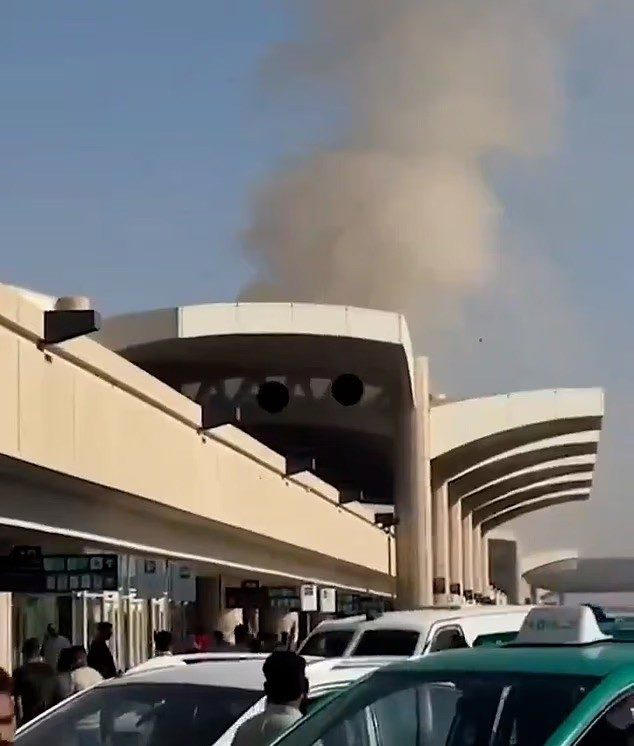
King Khalid International Airport was attacked again on Sunday
The raid was the latest in a series of Houthi attacks on locations across the Kingdom including airports and oil and gas facilities.
Britain’s embassy in Saudi Arabia has advised against all travel to the country’s airports as well as the cities of Jeddah and Dammam.
Houthi rebels control a significant pocket of territory in Yemen and have fought a long war against a Saudi-backed coalition. The conflict flared up this summer, triggering airstrikes from the Saudis and return fire from the Houthis directly into Saudi territory.
The attacks are causing damage and reputational tarnish for the kingdom, which prides itself on safety and a high level of internal control.
Saturday’s attack on Riyadh airport killed 13 including an American, an Indian, four Saudis, two Bangladeshis and one person each from the Palestinian territories, Jordan, Sudan, Syria and Egypt.
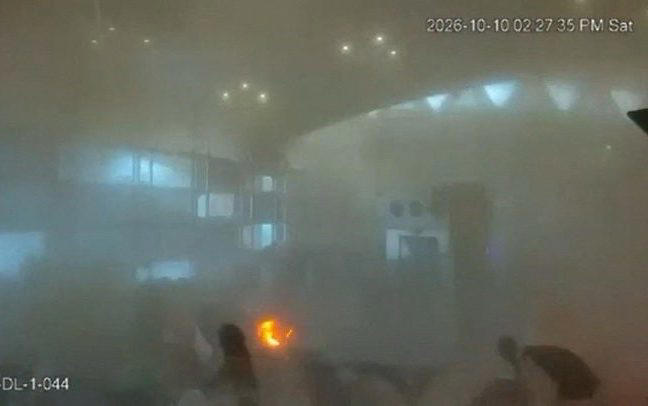
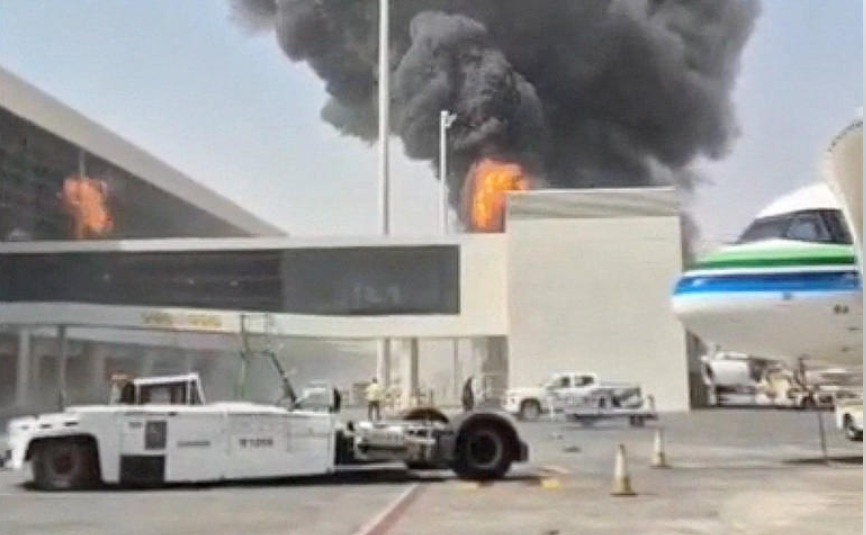
Surveillance footage shows smoke and flames at King Khalid Airport moments after Saturday’s attack – Saudi Ministry of Media/Reuters
Donald Trump later said he was considering joining Saudi Arabia’s war on the Yemen-based Houthis, which has intensified in recent weeks with the Kingdom backing a Yemeni government counter-offensive after the Houthis seized strategic territory along the Red Sea coast.
“We may. We’re going to look at it,” Mr Trump said. “We just found out about the recent attack… We move very quickly.”
The White House had said in September that it would not directly intervene in the conflict, but could provide intelligence support. It later confirmed it was supplying intelligence and military expertise to Saudi Arabia.
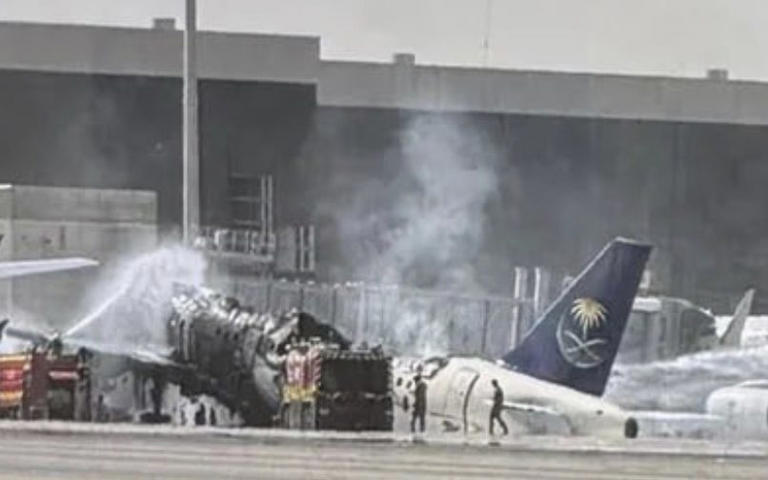
A commercial jet that was destroyed at Riyadh airport on Thursday
Eyewitnesses to Saturday’s Riyadh airport attack spoke on condition of anonymity because of harsh measures Saudi authorities have threatened against those who speak publicly about the strikes.
“The airport alarm sirens went off, and that’s when the panic started,” one 32-year-old Riyadh resident said.
“People who were in Terminal 3 started running towards us. Some had blood covering their faces,” they recounted.
“Some had lost a hand or an arm. People were running while carrying injured people, covered in blood.”
“My blood ran cold. I didn’t know where to go or what to do.”
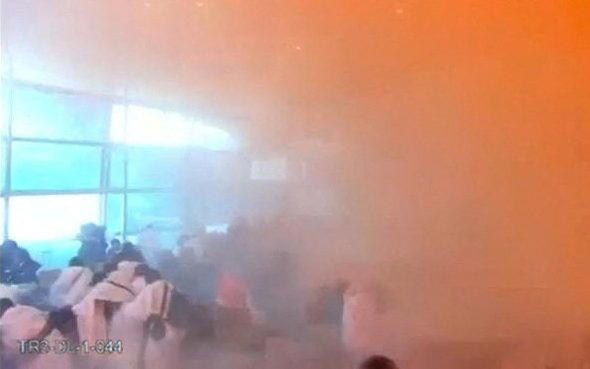
Airport security cameras captured scenes of panic moments after Saturday’s attack – Saudi Ministry of Media/Reuters
King Khalid International Airport is one of the busiest in the Middle East. Around 50 airlines use it to transport tens of thousands of passengers every day. It has been closed since the Houthis began attacking it on Friday evening.
At Riyadh hospitals, the health ministry activated emergency protocols to handle a mass-casualty event, with doctors ordered to report to medical facilities across the capital.
“The numbers were far higher than anything I had ever seen here before,” one doctor in Riyadh said, adding some religious pilgrims bound for Mecca arrived with their white shrouds stained with blood.
“Patients had severe limb injuries and shards of glass embedded in their faces and eyes,” he added.
“At least four people suffered severe nervous breakdowns.”
The Houthis put out a statement taking responsibility for the attack and reiterating its warning to all people not to operate flights to Saudi airports.
A spokesman said the group’s actions were in response to “brutal Saudi aggression against our country and our people” and claimed Saudi Arabia launched 124 air strikes in the past 24 hours at Houthi-controlled Yemeni territory.
Trump may join Saudi war after Saturday’s Houthi strike on airport killed 12
A five-day WPC Energy Congress is taking place this week at a convention centre some six miles from Riyadh airport.
State TV said more than 70 ministers, 300 company executives and representatives of more than 25 international energy organisations had confirmed their attendance.
It was not immediately clear whether the participants would attend in person or virtually.
A ministerial meeting of the International Energy Forum was also set to go ahead on Sunday, with its plenary session to be held behind closed doors, according to a media advisory.
Separately, Saudi authorities notified parents that schools would switch to remote learning until Thursday.