Barack Obama held up Northern Ireland’s Good Friday Agreement as a “shining example” of how to resolve bitter conflicts such as the Israel-Hamas war.
The former US president drew parallels between the Troubles and the war in Gaza as he visited Belfast on Tuesday, warning that deepening divisions and hardening attitudes made work towards lasting peace increasingly difficult.
Speaking to a packed audience at Belfast’s O2 arena, Mr Obama said he was “not as hopeful as I want to be in the short term” given the “aftermath of what’s happened in Gaza and the nature of political changes that have taken place in Israel”.
The “strengthening of Right-wing forces inside of Israel”, the expansion of the settler movement and “the constant changing of the facts on the West Bank” were diminishing hopes for peace, he argued.
“I think the hardening of attitudes inside of Israel after October 7 means that we have to probably work for a genuine cessation of violence and relief for the people of Gaza as a step then to even talk about … long-lasting peace,” Mr Obama said.

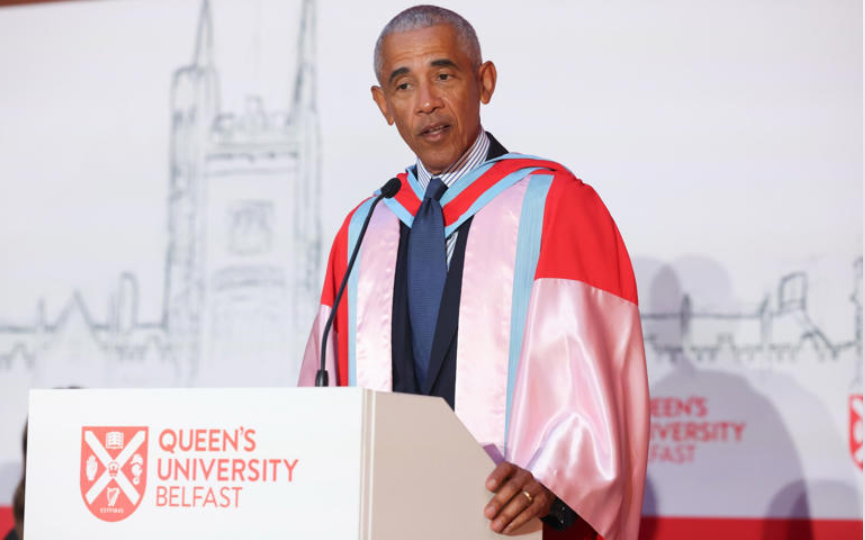
The former US president received an honorary degree from Queen’s University Belfast – PA/Queen’s University Belfast
Mr Obama compared the divisions fuelling the conflict between Israelis and Palestinians to those that plagued Northern Ireland during the Troubles, when three decades of sectarian violence claimed more than 3,500 lives.
Describing the forces behind such conflicts as a “tribal, elemental, unforgiving divide”, he warned that grievances could become so entrenched that each side ceased to recognise the humanity of the other.
“It’s a sort of madness once it breaks out,” Mr Obama said.
“And the sense of grievance on either side feeds on itself to the point where, ‘I cannot even see that other person’, and it will justify anything.”
But he pointed to the 1998 Good Friday Agreement, which helped bring an end to unrest in Northern Ireland, as proof that even seemingly intractable divisions could be overcome.
“The Good Friday Agreement came about not just because of exhaustion and people being weary of violence,” Mr Obama said.
“It was also – somebody started imagining something better, and they saw themselves and each other in a different kind of way.”
He urged people not to abandon hope and to “insist that we can do better than we’re doing right now” as he spoke about striving for peace at a time of global instability.
Mr Obama said: “People ask me sometimes how I can still be hopeful. It’s an assertion. It’s a practice. It is me saying: this is how I prefer to live.
“I am going to assume the best in people. I am going to be willing to recognise my own flaws and consider how I can be better.
“I’m going to insist that we can do better than we’re doing right now.
“And there’s something in us that recognises ourselves and others, that has an impulse towards kindness, but also an impulse towards cruelty, and I know which side of that contest I want to be on. And I will fight for that, even if I don’t always think it’s going to win.”
Earlier in his visit to the city on Tuesday, Mr Obama praised Northern Ireland’s progress towards peace as he accepted an honorary doctorate from Queen’s University Belfast.
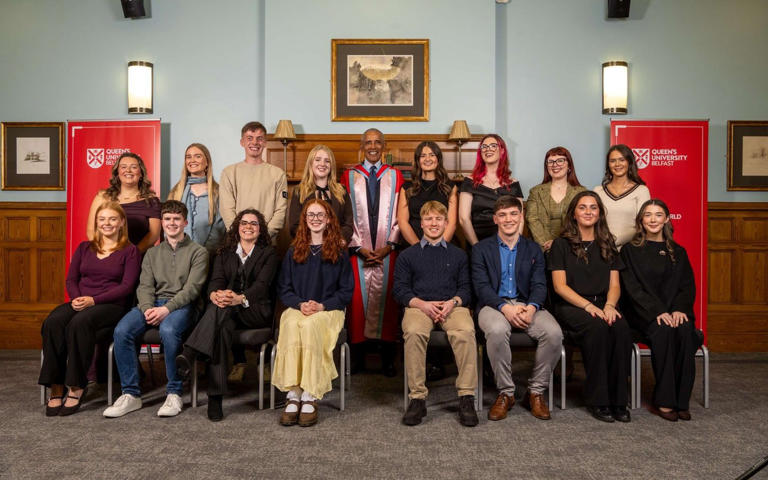
Mr Obama encouraged students in Belfast to continue building a peaceful future – Queen’s University Belfast
He told students at Queen’s: “The Good Friday Agreement is still a shining example of what can happen when people put aside old wounds and choose peace.
“But as we have seen in many countries, including in my home country the United States, peace and democracy are not inevitable. They have to be chosen, again and again.”